Why Meditation Is More Than Relaxation? | Buddhist Meditation Course in Richmond BC

When people hear the word "meditation," they often think of stress reduction, relaxation, or finding a moment of peace in a busy day.
While meditation can certainly help us feel calmer, its purpose goes much deeper.
Living on Autopilot
Many of us spend much of our lives on autopilot. Our bodies are in one place, but our minds are somewhere else—replaying past conversations, worrying about future possibilities, or getting caught in endless streams of thought. Over time, this constant mental activity can leave us feeling exhausted, disconnected, and overwhelmed.
Meditation as Training the Mind
Meditation offers a different way of relating to our experience.
Rather than trying to suppress thoughts or force the mind to become blank, meditation teaches us to observe what is happening in the present moment with greater clarity and awareness. We learn to notice our thoughts, emotions, physical sensations, and reactions without immediately being pulled around by them.
In the Buddhist tradition, meditation is often described as training the mind. Just as physical exercise develops strength and endurance, meditation develops qualities such as attention, emotional balance, patience, and self-awareness.
Mindfulness of Breathing
One of the first practices practitioners learn is mindfulness of breathing. The breath becomes an anchor that helps gather a scattered mind. As attention stabilizes, many people begin to notice something surprising: calmness is not something they create. It is something that naturally emerges when the mind becomes less distracted.
Mindfulness of the Body
Another foundational practice is mindfulness of the body. By learning to pay attention to simple experiences such as walking, standing, sitting, and breathing, we begin reconnecting with the present moment. This can be especially valuable for individuals who struggle with anxiety, stress, overthinking, or emotional overwhelm.
Loving-Kindness Meditation
Loving-kindness meditation begins by intentionally cultivating wishes for well-being and happiness—first toward ourselves, then extending those wishes to loved ones, neutral people, difficult people, and eventually all living beings.
This practice is not about forcing positive emotions. Rather, it is about gently training the mind to respond with kindness rather than judgment, anger, or ill will.
Many practitioners find that loving-kindness meditation helps reduce feelings of anger, suffering, and self-criticism while fostering greater patience, empathy, and emotional resilience in daily life.
Meditation is not about becoming a different person. It is about developing a clearer relationship with ourselves as we are.
Over time, this practice can help us respond rather than react, cultivate greater self-understanding, and approach life with more steadiness and compassion.
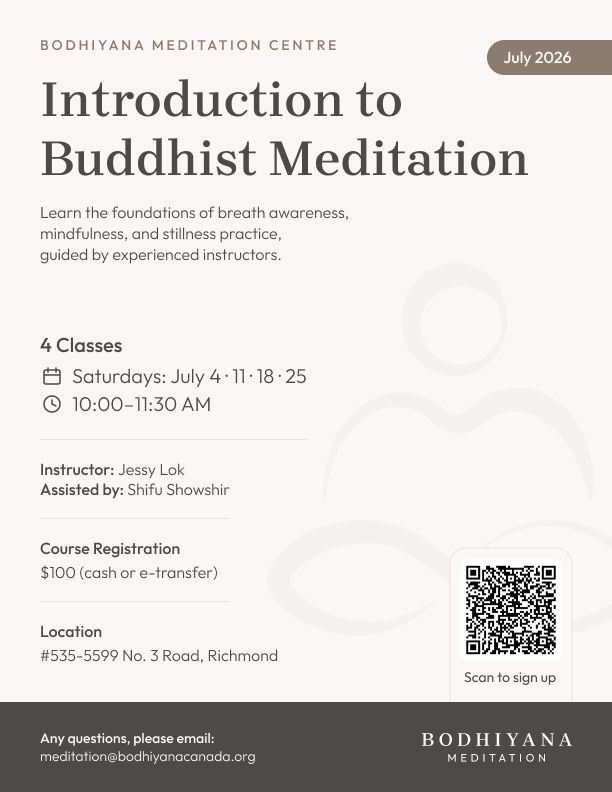
Introduction to Buddhist Meditation Course in July 2026
This July, I will be offering another Introduction to Buddhist Meditation course, where participants will learn practical mindfulness and loving-kindness practices in a supportive environment. No previous meditation experience is required.
Any questions, please email: meditation@bodhiyanacanada.org



Comments